
Water Service
Dependable, quality water for our community.
WATER SERVICE INTERRUPTED?
Report an Outage.
Water Outage Line
BY THE NUMBERS
Built for Our Community
Serving 53,000 homes and businesses across Wyandotte County and beyond with safe, reliable water since 1909.
53,000+
Water customers
served across Wyandotte County and beyond.
1,004 Miles
of water pipes
delivering up to 72 million gallons of treated water every day.
6,242
Fire hydrants maintained
Inspected and serviced regularly to keep our community safe.

Gold Award for Competitiveness Achievement
For initiatives in the areas of plant, maintenance, engineering, finance and employee development.
WATER SERVICE
How Our Water Service Works
Your water travels hundreds of miles before reaching your tap. We collect it from beneath the Missouri River, treat it at our state-of-the-art facilities, and deliver it through 1,004 miles of pipe, up to 72 million gallons every day.

STAGE 01
Source: The aquifer
BPU draws water not from the Missouri River itself, but from the aquifer beneath it, fed by snowmelt from the Rocky Mountains in Wyoming and Montana. Two of the nation’s largest horizontal collector wells gather this naturally pre-filtered water from deep below the riverbed.
STAGE 02
Treatment: Nearman & Quindaro
Water is pumped to BPU’s two treatment facilities at Nearman and Quindaro, where it passes through sediment basins and multiple stages of filtration. Chlorine is added to eliminate bacteria, fluoride is added to help fight tooth decay, and the water is tested continuously to confirm safety.
STAGE 03
Delivery: To your tap
From four pump stations, treated water is pushed through 1,004 miles of pipe to homes and businesses across Wyandotte County, Edwardsville, parts of Bonner Springs, southern Leavenworth County, and a portion of Johnson County. 31 million gallons of reservoir storage keeps service steady.
CUSTOMER RESPONSIBILITIES
Understanding Utility vs. Customer Responsibilities
From the water main to your tap, knowing the boundary helps avoid surprises. BPU maintains the public water system; you’re responsible from the first control valve into your home.
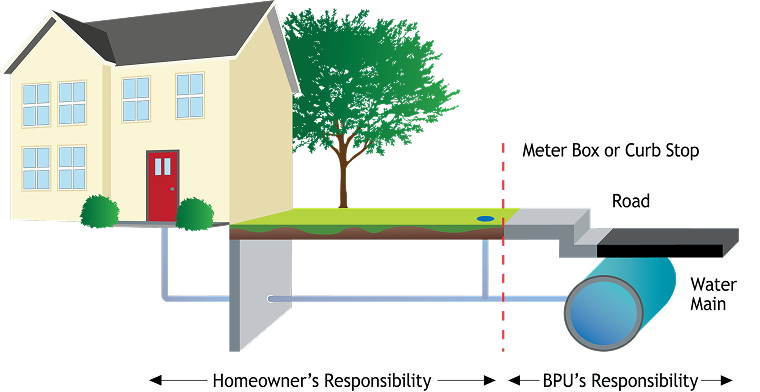
BPU maintains the water main, curb stop, and meter box at the street. Everything from the curb stop into your home is your responsibility.
Customer Responsibilities
Your water meter
Water service is supplied using an indoor or outdoor meter. Report water running outside and outages to the Water Outage Line at 913-573-9622.
Leak repairs
Owner must call a Wyandotte County licensed plumber for leak repairs. The plumber must contact 913-573-9843 for the required maintenance permit.
Shut-off valve
The shut-off valve inside the house controls water flow in the home. Find out where it is and how to turn it off for emergencies and home repairs.
Water issues or concerns
For water issues or concerns, please call 913-573-9622.
Public sewer lines & storm drains
Maintained by UG Public Works. For storm drains call 913-573-5400. For public sewer lines call 913-573-5535.
Watch our video to understand how our roles intertwine and clarify which responsibilities are BPU’s and yours.
OUTAGES & MAINTENANCE
When Water Service Is Interrupted
Whether it’s planned maintenance or an unexpected break, here’s what to expect and how to reach us 24/7.
PLANNED WORK
Scheduled water maintenance.
If there’s planned maintenance in your neighborhood, if you have signed up you may receive an alert by call, text, or email. Here’s the four-stage process our crews follow on every job:
- Utility locates. Kansas One Call marks the water main and other underground utilities before any digging begins.
- Excavation & repair. Crews excavate (water lines run 3–10 feet deep), then replace pipe, install a clamp, or fit a new valve.
- Flushing. A nearby hydrant is opened to flush air and sediment. Recharging a line takes 10–30 minutes. Once your service is back, run a few faucets in your home for a few minutes until the water runs clear to flush sediment from your own lines.
- Restoration. A crew will backfill the hole or trench with gravel and prepare the roadway for patching. If it’s in the right-of-way, crews will reseed the area when temperatures allow.
EMERGENCY
Water break or running outside?
BPU monitors residential water meters that show continual usage for more than 24 hours. Be proactive and check for leaks around your residence, catching them early can reduce your costs.
Water outage line, 24 hours
Common sources include a running toilet, dripping faucet, an outdoor faucet left on, or lawn irrigation. If you’re unable to locate a leak or have further questions about continuous usage, contact water dispatch. If your water meter is located inside and you can’t identify a leak, we recommend contacting a licensed and bonded plumber to investigate.
Potential Water Leaks
BPU monitors water meters and notifies customers by text and email when water usage appears to be higher than normal or continues without interruption for an extended period. Because continuous water use can indicate a leak, it’s important to investigate these alerts to help prevent higher water bills and reduce water waste.
However, receiving a notification does not necessarily mean a leak is present. Household activities, irrigation systems, seasonal water use, and certain appliances can all contribute to increased water consumption and may trigger an alert.
Use the drop-down menu to learn more about common causes of high-water usage, how to identify potential leaks, and how to monitor your water use through MyMeter.
Common Causes Of High Water Usage
- Running toilets
- Dripping faucets
- Outdoor faucets or hoses left on
- Lawn irrigation or sprinkler system leaks
- Leaks between the water meter and your home
- Burst or damaged pipes
- Water softeners that are not operating properly
- Swimming pool filling or maintenance
- Guests staying in the home
- Seasonal outdoor watering
How To Check For A Leak
- Turn off ALL water use, including faucets, washing machines, dishwashers, sprinkler systems and outdoor hoses.
- Check your water usage through MyMeter. If your account continues to show water usage when no water is being used, you may have a leak.
- Check toilets by adding a few drops of food coloring to the toilet tank. Wait 10-15minutes without flushing. If color appears in the bowl, the toilet may be leaking.
MyMeter Information
MyMeter allows customers to:
- View daily water usage
- Identify unusual spikes in usage
- Track usage trends over time
- Better understand their utility bill
What does high water usage look like on MyMeter?
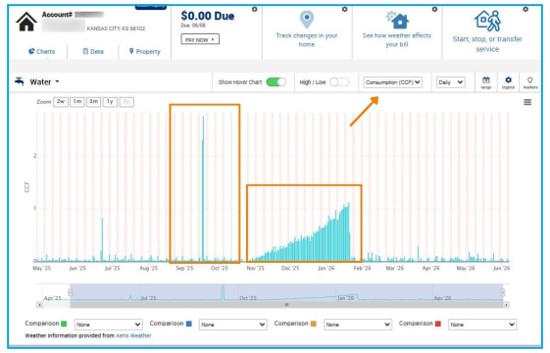
When viewing your usage history, be sure to select “Consumption” from the dropdown menu (see arrow above) to display your actual water usage.
This example shows two different types of high-water-use patterns. The spike in late September indicates a sudden increase in water consumption compared to surrounding days. One-time spikes like this may be caused by a leak or intentional water use, such as filling a pool, pressure washing, or seasonal outdoor maintenance.
The chart also shows a gradual increase in water usage from November through January. Unlike a single spike, a steady rise over time can indicate a continuous water-use issue, such as a leaking toilet, irrigation system malfunction, or another plumbing problem that worsens over time. The sharp decrease afterward suggests the issue was identified and corrected.
When the system detects water usage patterns that are significantly higher than your typical consumption (whether from a sudden spike or a sustained increase), it may trigger a text, email, or phone notification. These alerts can help you investigate potential leaks or other causes of high usage and potentially avoid a higher water bill.
FAQs
I fixed a leak. What should I do next?
- After repairing a leak, continue monitoring your water usage through MyMeter for several days to confirm the issue has been resolved. If your water usage remains higher than expected after repairs have been completed, additional investigation may be needed.
Does a leak notification mean I definitely have a leak?
- No, a leak alert is based on meter data that indicates continuous or higher-than-normal water use. While leaks are a common cause, other household activities may also increase water usage. Customers should investigate the cause of the usage and monitor their account through MyMeter.
Contacts
- If you are unable to locate a leak or have questions about your water usage, please contact Water Dispatch at 913-573-9622.
- If your water meter is located inside your home and you cannot identify the source of the water use, BPU recommends contacting a licensed and bonded plumber.
- For help accessing MyMeter contact Customer Care at custservice@bpu.com or 913-573-9190.
RESIDENTIAL RESOURCES
Protecting Your Water at Home
A few simple practices keep your water safe and your service line healthy. Start with these three.
BACKFLOW PROTECTION
Stop contamination before it starts.
When water pressure suddenly drops, during a fire response, or before a main repair, water can siphon backward through your hose. If that hose was in a pool, a bucket of soapy water, or near weed killer, contaminants can be pulled back into your drinking water.
Install inexpensive backflow prevention devices on every threaded faucet, indoors and out. Never submerge hoses, and keep the end clear of possible contaminants.
WINTER PREP
Keep pipes from freezing.
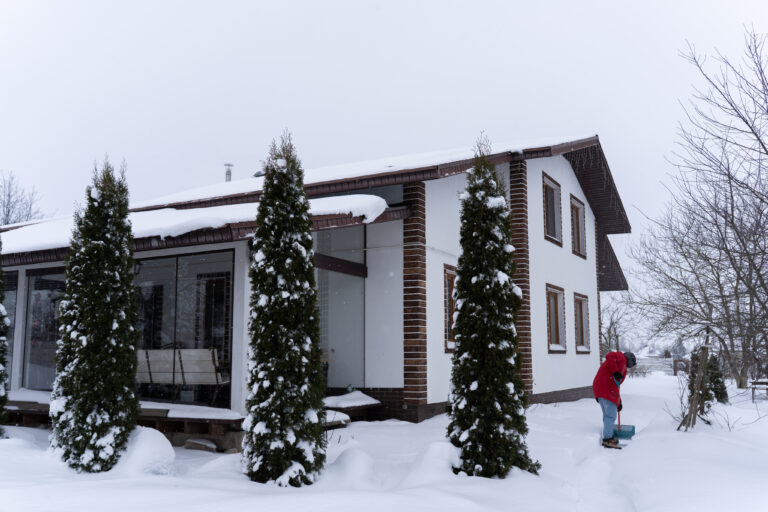
Cold weather can freeze or even burst water lines. When extreme cold hits, let faucets drip, open cabinet doors near plumbing, keep your thermostat steady day and night, disconnect outdoor hoses, insulate exposed pipes, and know where your main shut-off is. If you’re going to be away from home for a while, set the thermostat no lower than 55°F.
If pipes do freeze: shut the water main off first, then warm pipes with a hairdryer or space heater (never an open flame, and never leave them unattended). Once thawed, slowly turn the water back on and check for cracks or leaks. If you can’t thaw them, call a plumber.
LEAD & COPPER RULE
Know what’s in your service line.
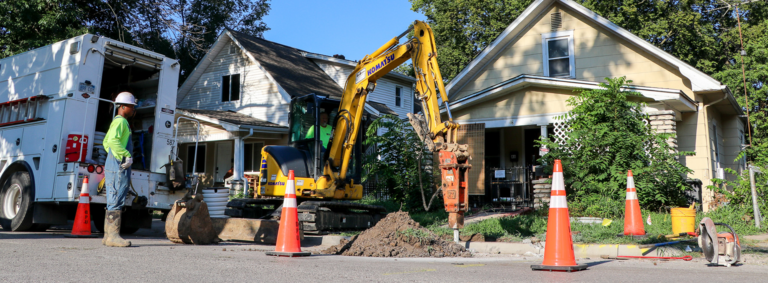
The EPA’s Lead and Copper Rule Revisions require utilities to inventory the materials in service lines across their territory. BPU staff reviewed historical drawings, meter records, and visited over 11,000 homes, even using a hydro-excavation truck for buried services.
Search BPU’s interactive Service Line Inventory map to see what materials connect your home to the water main.
Questions? Email LeadCopperRule@bpu.com
WATER FACTS
Did You Know?
A few facts about the water we drink celebrated each year during National Drinking Water Week, the first full week of May.

60%
of an adult body is water, making hydration essential to nearly every function.

2,600+
gallons of water wasted per year by a single faucet that drips once a second.

80,100
gallons of water used per person each day in the U.S., most of it for flushing.

25%
reduction in tooth decay when water is fluoridated, as BPU does.
FOR BUSINESS
Resources for Business Customers
Tools and forms for contractors, developers, and business owners working with BPU water service.
FORMS & PERMITS
Fire hydrant meter rentals
Need short-term water service for construction, irrigation, or temporary use? BPU rents metered hydrant connections in two sizes.
COMPLIANCE
Back flow assembly testing
If your property has a back flow prevention assembly, BPU requires it to be tested annually by a certified tester. Results must be submitted to BPU on the approved form.
SHARED RESPONSIBILITIES
Customer responsibilities
BPU maintains the water main and service line up to the first control valve; the property owner is responsible from there into the building.

Need Assistance?
Contact Customer Care. We’re here to help.